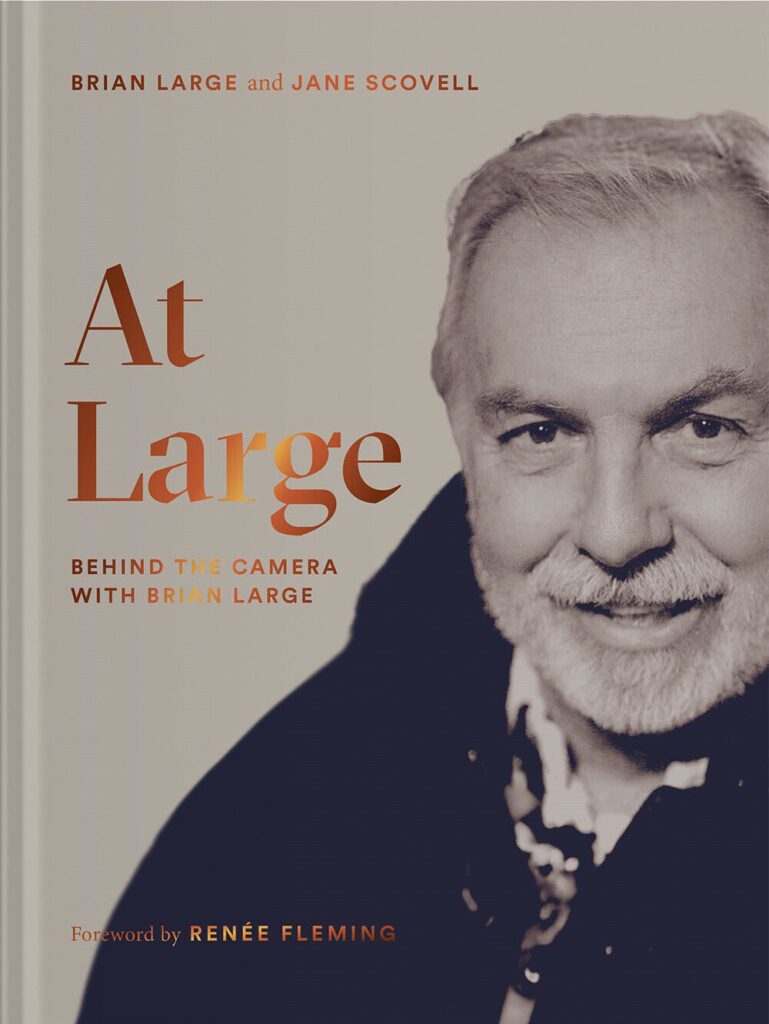
Brian Large’s name appears in the credits of more than eight hundred productions. As a director, he has worked with countless leading figures from the world of music and played an active role in shaping the modern music film since the 1960s. Now Brian Large, supported by Jane Scovell, co-author of autobiographies including those of Marilyn Horne, ElisabethTaylor and Ginger Rogers, has published his memoirs.
It is a fascinating read in every respect. Readers are granted deep insights into the profession, while a panorama of half a century of musical television history unfolds before their inner eye. Interwoven into the chronological narrative are numerous portraits of musical personalities—brilliantly drawn character studies written from the perspective of artistic collaboration. Open the hefty volume at almost any page, and you are instantly drawn in.
Across nearly five hundred pages, the now 86-year-old Brian Large recounts the key stages of his career. Raised in poverty as the child of a London family bombed out during the Blitz, the highly gifted pianist studied privately with Dame Myra Hess, earned a university degree, and—thanks to his versatility and fearless demeanour—secured a position as a video director at BBC2 in 1965, just one year after the cultural channel was founded.
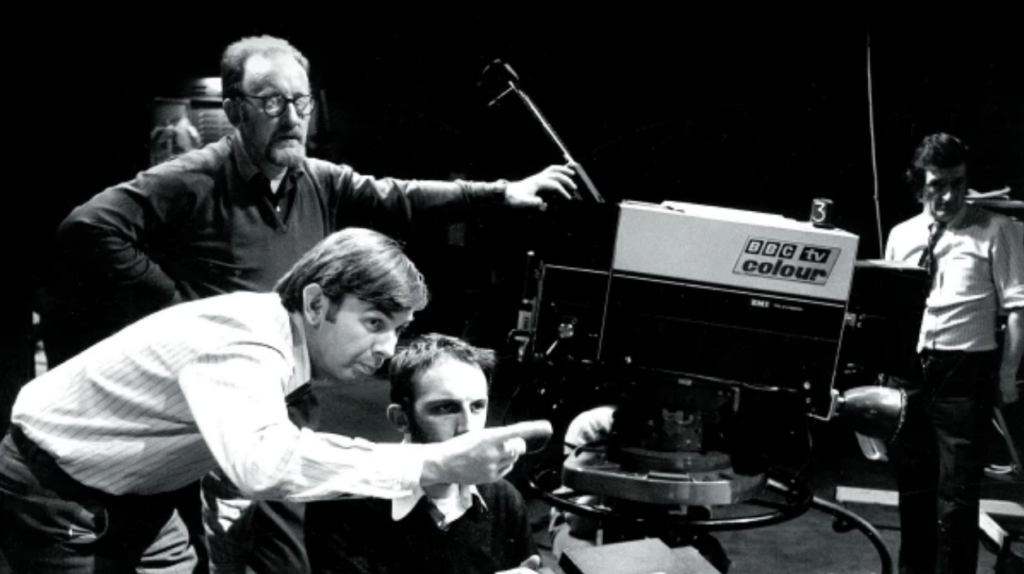
No sooner had he started than he was confronted with live television at its most demanding. Winston Churchill had died in January 1965, and at the Queen’s request, the funeral ceremonies were to be broadcast live. From St Paul’s Cathedral to Waterloo Station—where the coffin was transferred for its journey to Churchill’s family grave in West Oxfordshire—thirty-six cameras were installed along the route. The scale of equipment and the logistical challenge were unprecedented. The producer of this monumental undertaking was Tony Craxton, and Large was able to observe the production at close range as a novice. In his book, he meticulously describes the technical processes and the role of the producing director, who, with his gestural instructions, appeared to him like a conductor. It was here that his own vision of the future took shape: the television director as a “video conductor”.
The Euphoric Beginnings of the Music Film
Large’s account of the production conditions of the time is a first-hand retelling of media history. In the early days of music television, everything was recorded live and broadcast directly—an approach that demanded presence of mind and a great deal of improvisational skill. His supervisors and mentors were visionary figures such as Sir David Attenborough—whom Large describes as a brilliant educator and inspired programme-maker—and the “ear man” John Culshaw, who had previously produced Decca’s groundbreaking Ring cycle with Georg Solti. Artistic and technical challenges went hand in hand; as new media territory was being explored, there was enormous freedom. Objections from sceptics—“this won’t work” or “the audience won’t understand”—were unthinkable. Nothing slowed the prevailing sense of euphoria.
Large’s journeyman piece came in 1965 with the recording of a concert at the Royal Festival Hall, where the 82-year-old Igor Stravinsky conducted his Firebird Suite. Through extended close-ups of Stravinsky’s face—shots that would later become influential—Large created a unique artistic study of this towering figure of the twentieth century. The film has since achieved cult status and can still be seen on YouTube. Projects with conductors such as Solti, Bernstein, and Sir Adrian Boult followed, as did the live broadcast of the Last Night of the Proms, a technically and organisationally complex undertaking and a national event for British audiences. A substantial chapter is devoted to the intense and by no means easy collaboration with Benjamin Britten; Large’s portrait of the composer is a masterclass in psychological observation.
From the BBC to the Freelance Market
In 1980, Brian Large left the BBC—the institution that had made his career—and began working as a freelance director. He was interested in art, not in the career ladder that was offered to him. Looking back in a later chapter, he does so with both nostalgia and disillusionment. The pioneering spirit within the medium had faded, and the now ubiquitous, art-averse managerial mindset had begun to take hold.
Around 1980, opportunities on the freelance market were excellent. Private media companies such as Leo Kirch’s Unitel and the New York-based Columbia Artists agency began investing in classical music film. Independent producers also entered the scene: Reiner Moritz with RM Arts in Munich, Bernd Hellthaler with EuroArts in Berlin, Christopher Nupen with Allegro Films and Julian Wills with the National Video Corporation in London—each full of ideas and well connected with international opera houses and orchestras. It was a producer ecosystem in which the now internationally sought-after director Brian Large could land major projects.
Already in 1979, he had filmed the landmark Ring production by Chéreau and Boulez in Bayreuth. Engagements followed from London to Tokyo, from the Met to Salzburg. His Salzburg presence came to an abrupt end when Karajan attempted to hire him merely as an executor of his own ideas of visual direction—an offer Large politely declined. His account of the encounter with the “Emperor of Salzburg” has satirical qualities. Only after Karajan’s death was he able to work there again.
As a freelance director, Large was responsible for productions that made history: the politically fraught recital by Vladimir Horowitz in Moscow in 1986, organised by Peter Gelb; the legendary first appearance of the Three Tenors in Rome’s Baths of Caracalla in 1990. After that, he drew a line—the media circus that followed and turned into a bonanza for all involved no longer made artistic sense to him. Instead, he participated in the audacious 1992 Tosca project, broadcast live from the three original Roman locations in real time, from eleven in the morning until six the following morning. His detailed descriptions of such exceptional undertakings read with the suspense of a crime novel.
Stage Icons Seen Up Close
Brian Large was always more than a camera director. He contributed to interpretative discussions, initiated productions himself, and conducted intensive preparatory conversations with the protagonists. His portraits of artists are sharply drawn yet always marked by empathy. They illuminate both the artistic and human qualities of those portrayed, without ever slipping into uncritical admiration. Carlos Kleiber, the ballet dancer. Giuseppe Sinopoli, the most brilliant intellect he ever encountered. The eccentric and generous Leonard Bernstein, whose gradual decline Large describes with a sense of shuddering compassion. Or the incomparable Cecilia Bartoli. Particularly moving is the account of how, in 1993, she flew from Rome to London to help Large in the household after his father’s death—and sang Mozart’s Exsultate, jubilate at the funeral.
The portraits of great singers number in the dozens. Even when recounting personal moments, Large remains the English gentleman—for instance, when recalling how the 61-year-old Birgit Nilsson asked him for advice on how to behave in front of the camera, or how calmly Marilyn Horne responded to his cautious criticism of her stage presence. His relationship with Pavarotti, by contrast, was entirely uncomplicated. Pavarotti called him his favourite director and confided why he always carried a bent nail with him on stage: it brought good luck.
“You must be ahead of the game”
Large and Scovell tell all this in an accessible, everyday language, always marked by respect for both people and music. High-level expertise is conveyed with lightness; a touch of well-earned vanity occasionally shines through. Along the way, readers learn a great deal about the essentials of filming music—from camera placement to the age-old rule never to peer directly down a singer’s throat. Fundamental questions are discussed, such as what should take centre stage in a concert recording: the conductor or the work. Large addresses this through Bernstein’s recording of Sibelius’s Fifth Symphony and, unsurprisingly, arrives at the conclusion: the conductor. That one cannot simply film a scene but must first understand its inner drama and concrete stage situation is self-evident to him. He sums up its necessity with a simple sentence: “You must be ahead of the game.”
Perspectives for the Future
André Malraux, the French writer and Minister of Culture under de Gaulle, once predicted that the Louvre of the future would be audiovisual. With his impressive body of work, Brian Large has helped bring us closer to that vision. Musical awareness has changed, artists have developed new forms of behaviour in front of the camera, and new facets have emerged in the social perception of music. Seeing and hearing through media have become inseparable.
Large has always understood the power of images, yet he never succumbed to the temptation of turning music into the mere soundtrack of a visual spectacle. He remained a servant of music rather than of viewing figures—and his success proves him right. Today, we live in a time of cultural transformation, and it is not inconceivable that artificial intelligence, combined with new social processes, could one day strip classical music in the media of its soul. All the more reason to keep Brian Large’s artistic truths firmly in mind.
Brian Large and Jane Scovell: At Large. Behind the Camera with Brian Large. Foreword by Renée Fleming. Verlag für moderne Kunst, Wien 2025, 495 p. (in English language)
Print version of this text: A Fascinating Look at the History of Music Film, in: Shifting Stages. Performing Arts in the Digital Age, IMZ International Music + Media Center , Vienna 2026, p. 48-51.
see also: Die Geschichte des Musikfilms auf DVD